Native App vs Web App: Pros and Cons for Nepali Startup
You've got a great business idea. Maybe it's a food delivery service for Pokhara, an online tuition platform for high school students, or a fintech tool that helps small shopkeepers in Kathmandu manage their accounts. Whatever it is, at some point you'll hit the same wall almost every founder in Nepal hits: should you build a native app or a web app?
It sounds like a small technical decision. It isn't. This one choice affects your budget, your launch timeline, how many customers you can actually reach, and how much you'll spend fixing things later. Get it wrong, and you could burn through your seed funding building something your users never download, or worse, something that works but nobody can find.
The good news? You don't need a computer science degree to make this decision well. You just need to understand what each option actually does, where it shines, and where it falls short — especially in the context of Nepal's internet speeds, device habits, and startup budgets. That's exactly what this guide covers.
What is a Native App?
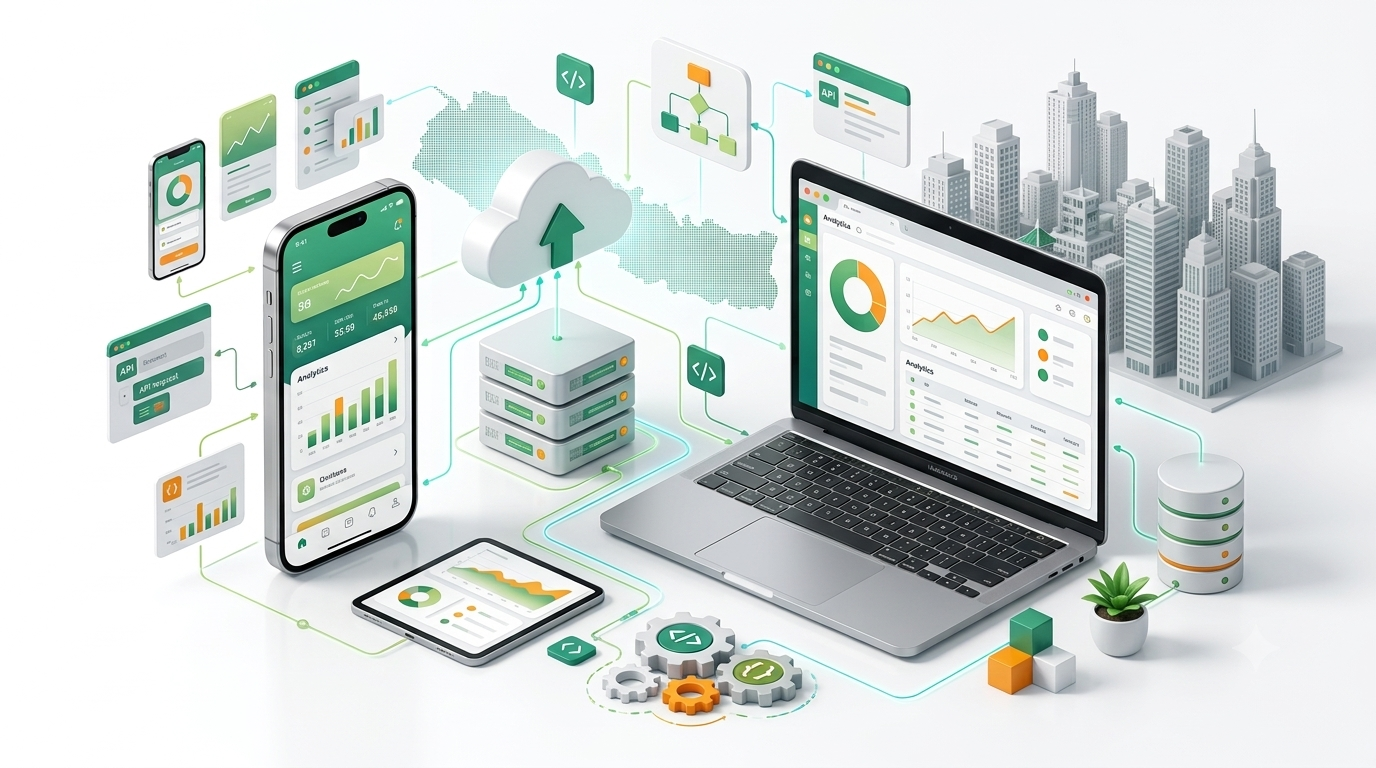
A native app is software built specifically for one operating system — either Android or iOS (iPhone). When you download an app from the Google Play Store or Apple App Store, that's a native mobile application. Because it's built using the specific programming language and tools of that platform (like Kotlin for Android or Swift for iOS), it can tap directly into everything the phone has to offer — camera, GPS, fingerprint sensor, push notifications, contacts, and more. This is why native apps usually feel fast, smooth, and "at home" on your phone.
Examples in Nepal: Pathao, Foodmandu, and eSewa all have native apps that users install directly on their phones. That's a big part of why they feel so responsive, even on an average internet connection.
What is a Web App?
A web app is software that runs inside a browser — Chrome, Safari, Firefox — without needing to be downloaded or installed. You simply visit a website address, and the app loads right there, whether you're on a laptop, an Android phone, or an iPhone. A special version of this is called a Progressive Web App (PWA), which behaves a bit like a native app. It can send notifications, work partially offline, and even show an icon on your home screen — all without going through an app store.
Examples: Twitter's (now X) lite web version, and many Nepali government service portals and school management systems run as web apps, since they're accessed mostly from desktops or don't need deep phone hardware access.
Native App vs. Web App: Key Differences
| Factor | Native App | Web App |
|---|---|---|
| Installation | Downloaded from app store | Accessed via browser, no install |
| Performance | Faster, smoother | Depends on internet and browser |
| Device features | Full access (camera, GPS, sensors) | Limited access |
| Development cost | Higher | Lower |
| Maintenance | Separate updates for Android/iOS | One codebase to maintain |
| Offline use | Often works offline | Usually needs internet |
| Discoverability | Through app stores | Through Google search |
| Update process | User must download update | Updates instantly for everyone |
Pros of Native Apps
1. Superior speed and performance Native apps are built for one platform, so they run faster and feel more polished. For businesses like food delivery or ride-hailing, where every second matters, this difference is very noticeable.
2. Full access to phone features Need to scan a QR code for payment? Use GPS for real-time delivery tracking? Send push notifications about a flash sale? Native apps handle all of this smoothly, which is why fintech and delivery apps in Nepal almost always go native.
3. Better offline functionality Nepal's internet connectivity, while improving fast, still has patchy spots — especially outside the Kathmandu Valley. Native apps can store data locally and work even with a weak or no connection, which is a genuine advantage for education and healthcare apps used in semi-urban and rural areas.
4. Stronger user trust and engagement An app sitting on someone's home screen gets opened again and again. It also benefits from the credibility of being listed on the Play Store or App Store, which still carries weight with Nepali users who are cautious about unknown websites, especially for anything involving payments.
5. Better security for sensitive data Banking, fintech, and healthcare apps that handle personal or financial information benefit from the stricter security layers native platforms provide.
Cons of Native Apps
1. Higher development cost Building separately for Android and iOS (or using a cross-platform app framework) usually costs more than building a single web app, since you need specialized native mobile application development skills.
2. Longer development time Expect a longer runway before launch, especially if you want both Android and iOS versions ready at once.
3. App store approval and rules Apple, in particular, has strict review guidelines. Rejections and delays are common, and they can push your launch date back unpredictably.
4. Update friction Every time you push a new feature, users need to download an update. Some never do, which means you'll always have people using outdated versions.
5. Ongoing maintenance for two platforms If you have both Android and iOS versions, you're essentially maintaining two products, which adds to your long-term cost.
Pros of Web Apps
1. Lower upfront cost This is the biggest reason early-stage Nepali startups lean toward web app development first. One codebase, one team, one budget — much easier on limited seed funding.
2. Works on any device, instantly No download, no storage space used, no waiting. Anyone with a browser and internet can use it, whether they're on a cheap Android phone or an office desktop.
3. Faster to build and launch You can go from idea to a live, testable product much faster, which matters a lot when you're trying to validate a business idea before spending big money.
4. Easier to update Push a change, and every user sees it instantly. No app store review process, no waiting for users to update.
5. Better for SEO and discoverability A web app can be found through Google search. This matters hugely for businesses that rely on people searching for services — like real estate listings, tuition classes, or local service marketplaces.
Cons of Web Apps
1. Limited access to device features Certain hardware features, like advanced camera controls or Bluetooth, are harder or impossible to access fully through a browser.
2. Depends heavily on internet quality If a user has a slow or unstable connection, a web app can feel sluggish or unresponsive — a real concern in parts of Nepal where 4G coverage is inconsistent.
3. No app store presence You miss out on the visibility and trust boost that comes from being listed on the Play Store or App Store, and some users are hesitant to enter payment details on a website they don't recognize.
4. Weaker offline capability Even with PWA technology, offline functionality is generally more limited compared to native apps.
5. Notifications are less reliable Web push notifications exist, but they don't reach users as consistently or effectively as native app notifications do, especially on iPhones.
Which One is Better for Nepali Startups?
There's no single right answer — it depends entirely on what your business needs and where your users are.
Choose a native app if:
You're in fintech, delivery, ride-sharing, or healthcare and need GPS, camera, or biometric access
Your users need offline functionality
You want to build long-term brand loyalty through app store presence and notifications
You have enough runway to invest in mobile app development in Nepal properly
Choose a web app if:
You're validating a business idea and need to launch fast on a limited budget
Your product is content-heavy or search-dependent (education platforms, real estate listings, blogs, service directories)
Your users primarily access your service from both desktop and mobile
You want maximum reach without asking users to download anything
A smart middle path: many successful Nepali startups actually begin with a strong web app to test their idea, build an audience, and start generating revenue — then invest in a native mobile application once they have the traction and funding to justify it. This phased approach reduces risk significantly. For businesses that genuinely need both experiences without doubling their budget, a cross-platform app (built with frameworks like Flutter or React Native) is often the practical middle ground — one codebase that runs on both Android and iOS, cutting cost and time compared to fully separate native builds.
Real-World Examples Across Industries
E-commerce: A growing online store might start with a web app for browsing and ordering, then build a native app once repeat customers justify the investment — similar to the path taken by many Nepali e-commerce brands.
Education: Online tuition and exam-prep platforms often do well as web apps first, since students and parents search for courses on Google before ever thinking about downloading an app.
Healthcare: Telemedicine services benefit from native apps for features like video consultations, appointment reminders, and secure health record storage.
Food delivery: Native apps dominate here because of GPS tracking, real-time order status, and frequent push notifications — exactly why platforms like Foodmandu built native from the start.
Travel: Booking platforms often use a web app for search and discovery (since SEO drives traffic) paired with a native app for loyal, repeat travelers.
Fintech: Security and biometric login needs make native apps almost mandatory for digital wallets and banking tools.
Real estate: Listings platforms tend to perform best as web apps, since buyers usually discover properties through search rather than app downloads.
Common Mistakes Startups Make
Building a native app before validating the idea. Spending lakhs on a fully native mobile application before knowing if people actually want your product is one of the most expensive mistakes a first-time founder can make.
Ignoring their target users' actual habits. If your customers are mostly searching Google for solutions, a web app with strong SEO will outperform a native app sitting unused on a home screen.
Underestimating maintenance costs. Founders often budget for the initial build but forget that native apps need continuous updates, especially after Android and iOS system updates.
Choosing native for the wrong reasons. "Because that's what real apps look like" isn't a strategy. Every platform choice should map back to your actual business needs.
Skipping proper UI/UX design. Whether native or web, a confusing interface kills user retention fast. Good design isn't a luxury — it's often the difference between an app people keep using and one they delete after a day.
Not planning for growth. Building something that works for 100 users but collapses at 10,000 is a common and costly oversight.
Final Verdict
There's no universal winner in the native app vs web app debate — only the right choice for your specific business, budget, and timeline. If you need speed, offline access, and deep phone integration (think fintech, delivery, healthcare), native is worth the investment. If you need to launch fast, stay lean, and get found on Google (think education, real estate, service marketplaces), a web app is usually the smarter first move.
Many of the most successful businesses in Nepal didn't pick one and stick with it forever — they started with what made sense at the time and evolved as they grew. The real mistake isn't choosing "wrong" the first time. It's choosing without understanding your users, your budget, and your growth plan at all.
Ready to Build the Right Product for Your Business?
Choosing between a native app and a web app doesn't have to be a guessing game. At Maanjari Technology, we've helped startups and businesses across Nepal make this exact decision — and then build it right, whether that means mobile app development, custom web app development, intuitive UI/UX design, or a complete custom software solution built around your business goals. We also help you get found through digital marketing, so building the right product is only half the win — getting it in front of the right customers is the other half.
If you're planning your first digital product or thinking about scaling your existing platform, let's talk. Contact Maanjari Technology today for a free consultation, and let's figure out the smartest, most cost-effective way to bring your idea to life.